If we talk about traditional search engine optimization, SEO then it was built around simple standards; the pages that are ranking higher on the SERP eventually gain the attention of the visitors, converting them into potential customers. The current model for ranking is still present but no longer operational, as it doesn’t take businesses to their goal statements in terms of revenue generation.
Artificial intelligence, also known as AI, and conversational search tools are additional mediums for leads, and companies are investing heavily in it. They now look for the buyer and the search engine results pages, and summarize them to get the actual stats and know which pages are performing best on the SERP.
AI optimization has become a primary need; rather than competing only for the ranking that can be achieved through different content marketing techniques, you will compete with the references and recommendations.
Primarily, AI search engine optimization is sifting through pages to build a system of proof and clarity. Perhaps, generative SEO is the practical implementation of making your business website easily extractable and get verified instead of making it hard for humans to interpret the results.
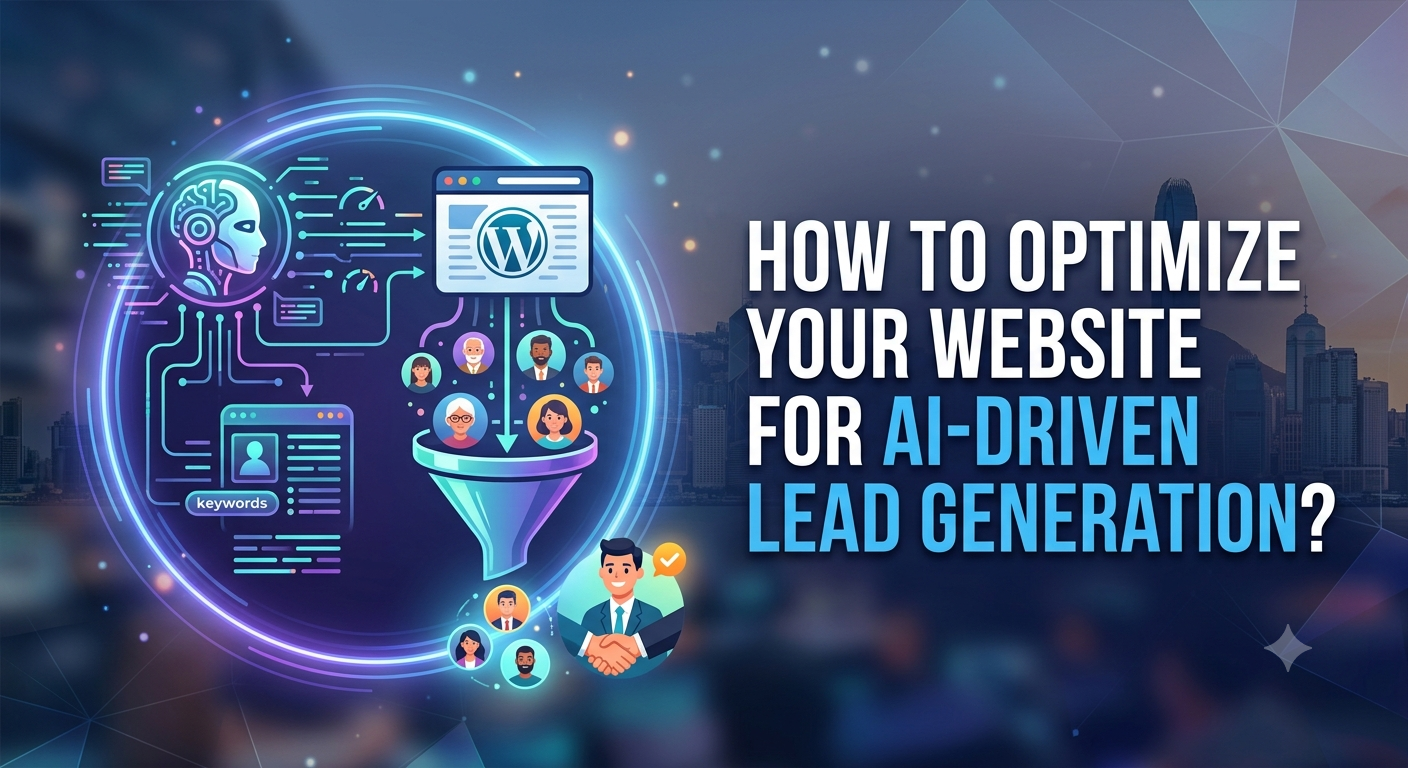
In this blog, we are going to discuss how AI has changed the complete lead generation dynamics. What matters for the lead flow and what to implement on the website so AI systems can surface businesses whenever customers ask for recommendations online.
Are you excited to explore it with us? Let’s get started then…
AI-Assisted Discoveries Are Reclaiming Some Part Of The Searches, Not Everything!
You may see major shifts in how searches are evaluated right now. Most of the buyers are now using AI to compress the changes in the early-stage spread, reducing the number of websites they require before forming an opinion.
This shift has already been reflected in the industry in many ways. According to Gartner, the search engine volume will drop by 25% due to AI chatbots and other AI agents available online.
So, for most of the businesses operating online, it’s a clear red flag. Fewer traditional searches indicate fewer chances to win the click race unless you show up on top after the AI-powered queries.
In such cases, buyers (Customers) are mostly using AI to define the issue, look for options, compare the answers and approaches, and identify the warning signs.
Therefore, to compete with the change, buyers should come with pre-built narratives and more specific questions. Your business website should do two jobs: support the traditional organic standards, and support AI-assisted discovery as well.
Why Do Recommendations Matter More Than Ranking Higher On SERP?
Search engine rankings measure on surface only, whereas if we talk about AI discoveries, then it introduces you to another surface area as well. Whether you become part of the answers.
Here are the three possibilities:
- Your business website is evaluated without any visit:
Most assistants summarize the information based on the details they get from public pages. Whereas, if your content is not informational, then you may lose the chance to be included on the top-tier pages.
- Proofs need to be easier
AI assistants prefer claims that are restated with low risk and referred with links, which means if your proof needs to be easy to find, then it would be counted on top. It comes with better processes, constraints, outcomes, and case studies.
- Conversion performance still decides return on investment
AI sends fewer but high-intent visitors, and all the sessions matter in this case. That is why conversion rate optimization, CRO, is very important for businesses who wish to market the product pages.
6 GEO Fundamentals That Improve AI Visibility
If you wish to get your content ranked higher by the AI assistant and its discovery plan, then you need to build the information to be extracted in that way. The following are the key attributes that should be followed to take the spot:
- Content Structure for AI Extraction
Before the advent of AI assistants, the best way of writing was to write clear, immediate answers to the customers. Instead of adding vague information or fluff just to increase the length of the writing pieces. Whereas now, after AI-powered extraction;
One should write 1 to 2 sentences directing the answers to the queries and then expand the paragraph.
Using descriptive headlines that match the queries.
Putting links to support the information, steps, and requirements into bullet format.
Adding key constraints in tabular format.
This is the stage where you will stop just “writing” but will “answer the queries” directly following the AI assistant practices.
- Building Topical Authority of the Services/Products:
The instant coverage of keywords assists in building authority and comes from a full evaluation process that includes most of the competitors.
Authority-building page includes outlining the process and deliverables along with timelines, who it is for – the pages. Are you adding industry pages with use cases and case studies with proven statistics that showcase the outcomes and context?
At this stage, content marketing services take place, and you may collaborate with Red Digitals for further guidance and discussion.
- Optimisation for Conversational Queries
Conversational content is not always done at the start of the business; instead, it takes time. If you want AI assistants to choose your written blogs, then you need to mirror the way buyers ask the question and then answer them most engagingly. To optimise the content for AI search, you may publish content that answers queries like,
• “What is the best approach for X if we have Y constraint?”
• “What should we do first if performance has dropped?”
• “How long will the results take, and what affects the timeline?”
- Strengthen Entity Signals Across Your Site
Entity is basically how the system will reduce the confusion, and your job as a marketing specialist should be to remove the inconsistencies from the things that create uncertainty and confusion.
Entity checklist:
• Standardize service naming across navigation, H2s and internal links
• Publish credible leadership and author bios
• Align About, services and proof pages so they reinforce one narrative
• Keep location and service-area info consistent if relevant
- Publish Answer-Ready Content
You should share content that passes the assistant’s acceptance criteria and the content is ready to be reused Whereas, this means you need pages that are built for summaries, and not just scanning.
The answer ready assets are:
- Pricing guidance which includes ranges, what changes the price, and what is included.
- Implementation timelines and what happens in the first 30 to 60 days
- Comparisons (“in-house vs agency,” “SEO vs. PPC”) with decision criteria
5 Common Mistakes That Reduce Discovery and Lead Quality
Here are the most common mistakes that reduce discovery and lead quality:
- Publishing blogs that might sound helpful but are not meeting the context of search queries.
- Making claims without any proof or writing statistics without any solid citation.
- Inconsistent service naming across pages, which creates extraction errors
- Treating AI lead generation SEO like a content volume play rather than a proof of system.
Collaborate with Red Digitals for better Strategies
Red Digitals, a leading digital marketing agency, has always been on top when it comes to assisting businesses with AI-assisted discovery plans. It means visibility matters. Ranking is also important but recommendations also increase on who gets the chance to be considered. The winning system is quite simple: you may publish the extracted answers and align the entity signals with back claims and proofs that protect accessibility concerns with strong technical fundamentals.
If you think we have missed anything within the blog, then feel free to let us know. We would love to hear it back from you.